

Wireless communications have achieved higher data rates and larger capacity by increasing carrier frequencies. While millimeter-wave bands are used in fifth-generation (5G) systems, next-generation (6G)(Note 1) communications, expected to be deployed in the 2030s, aim to utilize terahertz waves above 300 GHz. However, beyond 350 GHz, conventional electronic technologies face fundamental limitations in signal generation, including reduced output power and increased phase noise, making stable and high-speed wireless transmission difficult.
To address these challenges, a research team comprising Dr. Yu Tokizane, Dr. Hiroki Kishikawa, Prof. Naoya Kuse, and Prof. Takeshi Yasui of the Institute of Post-LED Photonics (pLED) and the Institute of Photonics and Human Health Frontier (IPHF), Tokushima University; Mr. Takumi Kikuhara of the Graduate School of Sciences and Technology for Innovation, Tokushima University; Visiting Professor Tadao Nagatsuma of pLED, Tokushima University; and Prof. Shintaro Hisatake of Gifu University, developed a microcomb-driven terahertz wireless communication system that combines terahertz wave generation using a fiber-coupled microcomb(Note 2) with high-order modulation techniques. By leveraging the high frequency stability of the microcomb, the researchers generated a low-phase-noise terahertz carrier and demonstrated single-channel wireless transmission at 112 Gbps in the 560 GHz band. This represents a significant increase compared to conventional terahertz communication systems, typically limited to a few to several tens of Gbps.
This work is the first to demonstrate the feasibility of 100 Gbps-class wireless communication beyond 420 GHz, and it provides a key technological foundation for ultra-high-speed backhaul links and photonic–wireless integrated networks in 6G systems.
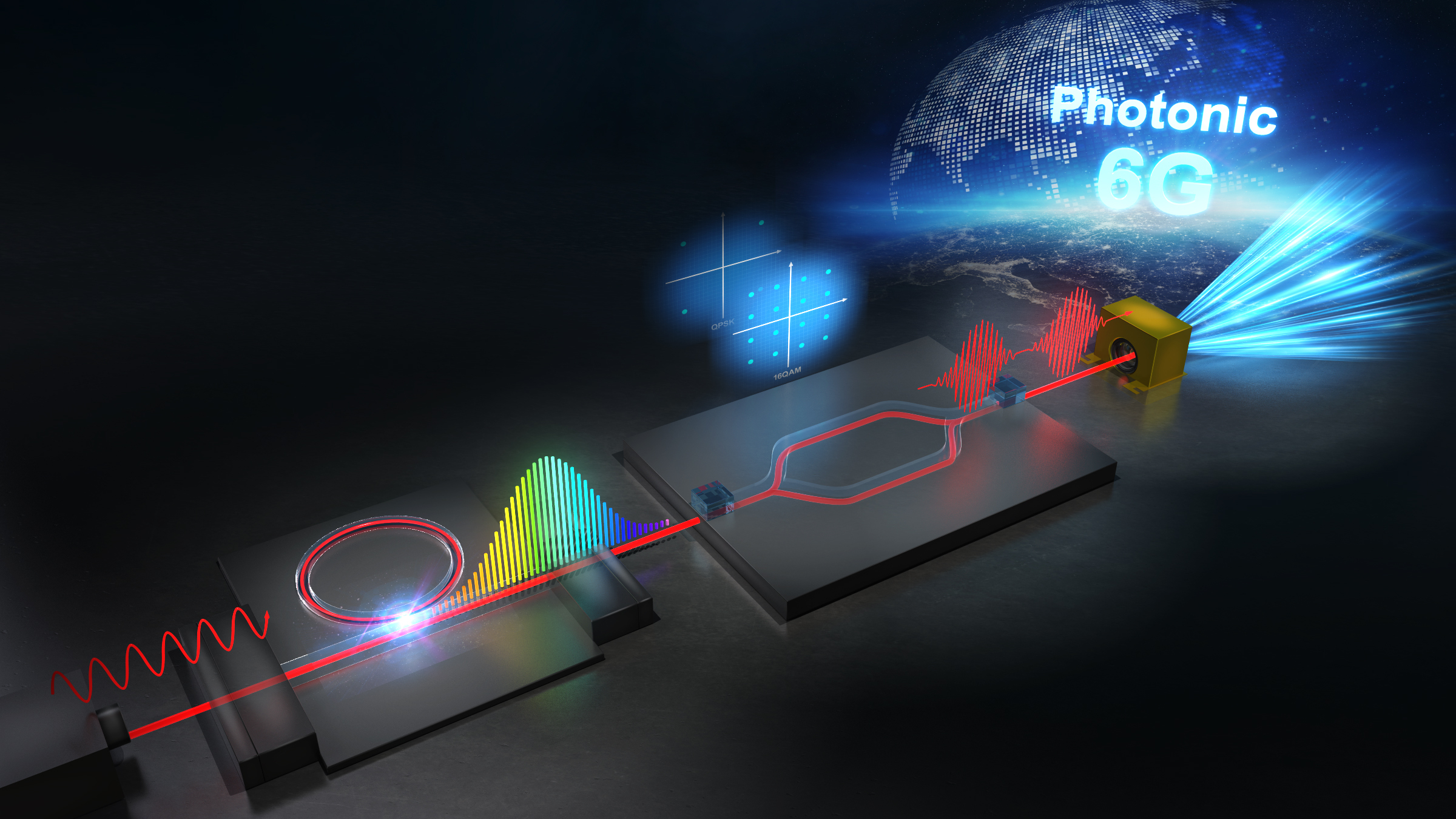
Conceptual illustration of microcomb-driven terahertz wireless communication.
Terminology
(Note 1) Next-generation mobile communication (6G)
In next-generation mobile communications (sixth-generation mobile communication, 6G), which is expected to be deployed in the 2030s, terahertz waves above 300 GHz are anticipated to be used as wireless carriers. 6G is expected to meet several key requirements, including ultra-high-speed and high-capacity communication, ultra-low latency, extended coverage, ultra-reliable communication, low power consumption and cost efficiency, as well as massive connectivity and integrated sensing.
(Note 2) Fiber-coupled microcomb
A microcomb is a highly discrete multi-spectral structure in which multiple optical frequency modes are arranged at equal intervals like the teeth of a comb. It enables the generation of ultrahigh-frequency optoelectronic signals with significantly higher quality than those obtained using conventional electronic approaches. In addition, microcombs can be mass-produced using semiconductor fabrication processes, making them promising for future miniaturization, simplification, and cost reduction.
In the fiber-coupled configuration used in this study, an optical fiber is directly bonded to the microresonator, enabling highly stable and reproducible optical coupling. This approach eliminates the need for precise optical alignment required in conventional systems and offers significant advantages for practical implementation.
【Press Release】First demonstration of 100 Gbps-class wireless transmission beyond 420 GHz: Toward ultra-high-speed mobile backhaul for 6G(PDF 704KB)
