│Return to list│Previous page│Next page│
| <L-09>:Life Science, Pharmaceutical Sciences |   |
Lysoplasmalogen as a Biomarker for Skin Inflammation and Barrier Function
― A Novel Bioactive Lysophospholipid Involved in Skin Homeostasis and Chronic Inflammatory Skin Diseases ―
| Kei Yamamoto | Professor |
| Applied Bioscience, Bioengineering, Division of Bioscience and Bioindustry, Graduate School of Technology, Industrial and Social Sciences | |
| Keywords | Skin barrier, wound healing, chronic inflammatory skin diseases, lysophospholipids |
| Laboratory URL |
| Research Overview | |
| ● Regulation of Skin Homeostasis Is Essential for Epidermal Barrier Formation The skin, which covers the body surface, forms a barrier to prevent transepidermal water loss, blocks the invasion of pathogens and allergens, and serves as a site where immune responses to foreign substances are initiated. We have demonstrated for the first time that lysoplasmalogen (P-LPE) is produced in the stratum corneum by the epidermal phospholipid-metabolizing enzyme sPLA2-IIF. Furthermore, we found that P-LPE acts as a detrimental factor that promotes abnormal proliferation, differentiation, and activation of epidermal cells, thereby contributing to the development of chronic skin inflammation. ● Technical Challenge: Maintenance of Skin Homeostasis through Regulation of Lysophospholipids Maintenance of skin homeostasis requires acidification of the epidermis. Under acidic conditions, P-LPE is non-enzymatically converted into acetal-type P-LPE (A-LPE). Among these species, newly generated A-LPE (trans) is thought to function as a beneficial factor that contributes to the restoration of skin homeostasis by promoting epidermal cell differentiation and migration, through mechanisms distinct from those of functional materials. Furthermore, epidermal P-LPE/A-LPE levels may serve as indicators of skin conditions and could be utilized for non-invasive evaluation or diagnosis of chronic inflammatory skin disorders. |
|
| Potential Applications and Commercialization Prospects | |
| ● Development of Novel Pharmaceuticals and Cosmetics for Skin Diseases The epidermal P-LPE/A-LPE pathway, as a biomarker reflecting skin inflammation and barrier status, may enable the following applications: 1. Pharmaceuticals and cosmetic ingredients: Development of pharmaceuticals and cosmetic formulations containing A-LPE or related compounds as active ingredients, including agents for promoting recovery from epidermal damage (e.g., sunburn and burns), preventive or adjunctive agents for atopic dermatitis and psoriasis, and functional cosmetics for skin maintenance and barrier restoration. 2. Diagnostic applications: Use of epidermal P-LPE/A-LPE levels or ratios as targets for diagnostic methods or evaluative methods to assess chronic skin inflammation and overall skin condition in a minimally invasive manner. 3. Therapeutic development: Development of therapeutic strategies for chronic inflammatory skin diseases based on inhibition or modulation of P-LPE production or signaling. 4. Impact statement: These findings establish the P-LPE/A-LPE pathway as a novel platform for controlling skin inflammation and restoring barrier function, providing new opportunities for the development of pharmaceuticals, functional cosmetics, and diagnostic technologies targeting skin homeostasis. 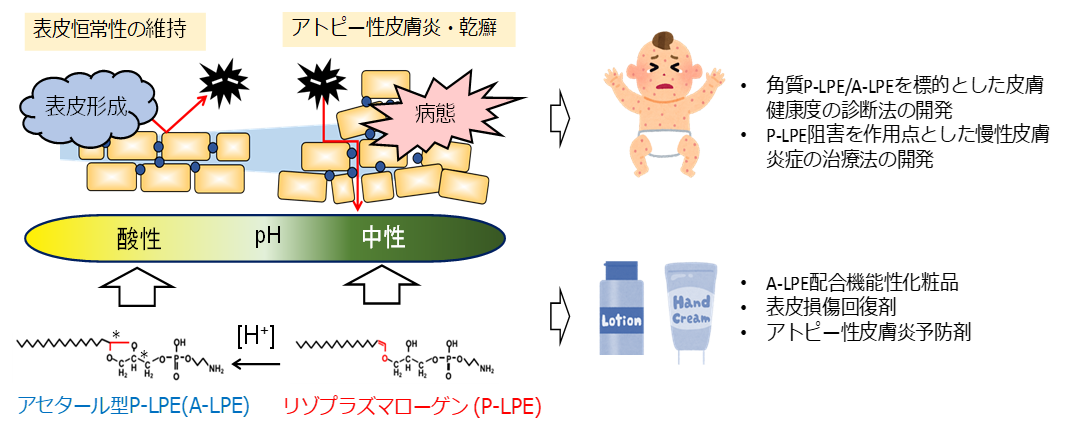 |
|
| ● Diagram explanation ・表皮恒常性の維持:Maintenance of epidermal homeostasis / 表皮形成:Epidermal development ・アトピー性皮膚炎・乾癬:Atopic dermatitis, psoriasis / 病態:Pathophysiology ・酸性:Acidic pH / 中性:Neutral pH ・アセタール型P-LPE(A-LPE):Acetal-type P-LPE (A-LPE) ・リゾプラズマローゲン(P-LPE):Lysoplasmalogen (P-LPE) |
• Development of diagnostic methods for skin health targeting epidermal P-LPE/A-LPE • Development of therapies for chronic skin inflammation targeting P-LPE inhibition • Functional cosmetics containing A-LPE • Epidermal damage repair agents • Preventive agents for atopic dermatitis |
| Patents | ● Japanese Patent Publication No. 2023-164036 “Lysophospholipids for promoting wound healing” | |
| Publications | ● K. Yamamoto, Elucidation of mechanism of skin homeostasis and disease regulation by plasmalogen-type lysophospholipid pathway, Annl. Rep. Cosmetol., 28, 162-166, (2020) ● K. Yamamoto et al., The roles of sPLA2s in skin homeostasis and disease, Biomolecules, 13, No.4, 668, (2023) ● H. Hakoi et al., Lysophospholipase D from Thermocrispum limits psoriatic inflammation by hydrolyzing epidermal lysoplasmalogen produced by group IIF secreted phospholipase A2, Biochimie, in press |
|
Last updated date:October 15, 2026
| Simple Inquiry | Technical consultation | Academic guidance system | Joint research/commissioned research |