│Return to list│Previous page│Next page│
| <L-10>:Life Science, Medical Devices |   |
Development of a Novel Clear Index System for Direct Composite Restoration
― Standardizing High-Quality Direct Composite Restoration to Advance Minimally Invasive Dentistry ―
| Keiichiro Watanabe | Associate Professor |
| Department of Orthodontics, Clinical Division, University Hospital | |
| Keiichi Hosaka | Professor |
| Department of Conservative Dentistry, Clinical Dentistry, Oral Science, Graduate School of Biomedical Sciences | |
| Keywords | Direct Composite resin restoration, clear index system, digital workflow, AI |
| Laboratory URLs | https://etanaka49.wixsite.com/website https://www.tokushima-u.ac.jp/dent/research/oralscience/clinical/36400.html |
| Research Overview | ||
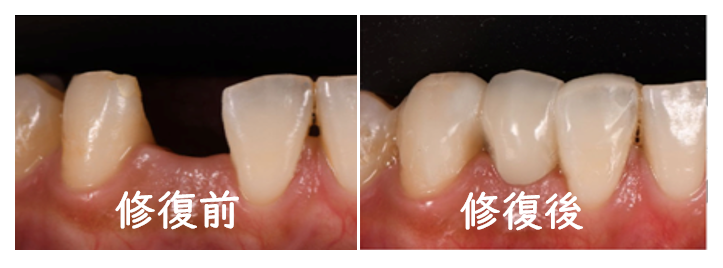
| ● High Precision Is Essential for Direct Composite Restorations in Minimally Invasive Dental Care In recent years, caries treatment has shifted from conventional metal inlays and crowns to minimally invasive approaches using reliable desntla adhesive system and light-cured resin composites. This approach minimizes tooth reduction and reduces the number of treatment sessions (Figure 1). However, as this technique requires advanced clinical skills and complex procedures, treatment outcomes largely depend on the operator’s expertise, resulting in variability in the final restorative morphology. ● Development of a Clear Index System Enables Highly Accurate Clinical Outcomes We have developed a clear index system utilizing digital technologies. The system consists of a flexible index made of a flexible material that reproduces the final restorative morphology and a stabilization holder that enhances the fit accuracy to the dental arch (Figure 2). By fabricating the index using a 3D printer based on digitally designed restorations, highly precise and reproducible final morphology can be achieved. |
||
| Potential Applications and Commercialization Prospects | ||
|
● Standardization of Direct Composite Restoration Using Clear Index and Stabilization Holder
|

| Patents | ● Japanese Patent No. 7671064 “DENTAL TREATMENT INDEX MANUFACTURING METHOD, DENTAL TREATMENT SYSTEM, AND DENTAL TREATMENT INDEX” ● Japanese Patent No. 7857681 “Dental treatment index and dental treatment set” ● WO/2024-228376 “DENTAL-TREATMENT INDEX, DENTAL-TREATMENT INDEX FIXING HOLDER, DENTAL-TREATMENT SET, METHOD FOR GENERATING THREE-DIMENSIONAL DATA OF DENTAL-TREATMENT INDEX, AND DATA FOR PREPARING DENTAL-TREATMENT INDEX” ● WO/2025-243648 “AUXILIARY INSTRUMENT FOR DENTAL TREATMENT, PHOTOCURABLE COMPOSITION, AND METHOD FOR PRODUCING AUXILIARY INSTRUMENT FOR DENTAL TREATMENT” |
| Publications | ● Watanabe K, et al. Restoration of a Microdont Using the Resin Composite Injection Technique With a Fully Digital Workflow: A Flexible 3D-printed Index With a Stabilization Holder. Oper Dent 2023. https://doi.org/10.2341/23-007 ● Muslimah DF, et al. Trueness and precision of composite injection technique: Roles of index design, composite flowabilities, and impression workflow. J Dent 2026. https://doi.org/10.1016/j.jdent.2025.106325 |
Last updated date:October 15, 2026
| Simple Inquiry | Technical consultation | Academic guidance system | Joint research/commissioned research |