│Return to list│Previous page│Next page│
| <E-02>:Mechanical Engineering |  |
High-Precision Positioning Control Technology for Pneumatic Actuators
― Achieving Both Contact Safety and Nanometer-Scale Precision in Collaborative Robot Applications ―
| Masahiro Takaiwa | Professor |
| Intelligent Mechanics, Mechanical Science, Division of Science and Technology, Graduate School of Technology, Industrial and Social Sciences | |
| Keywords | Pneumatic Actuators, High-Precision Positioning Control, Collaborative Robots, Industrial Applications |
| Laboratory URL | http://pub2.db.tokushima-u.ac.jp/ERD/person/292956/profile-ja.html |
| Research Overview | |||
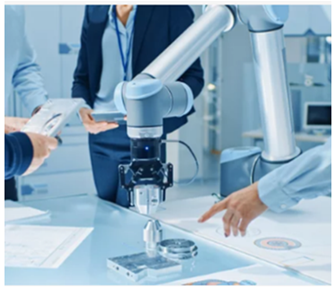
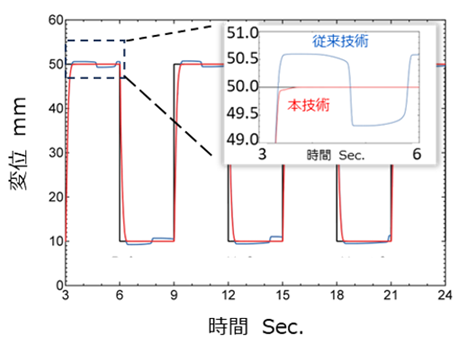
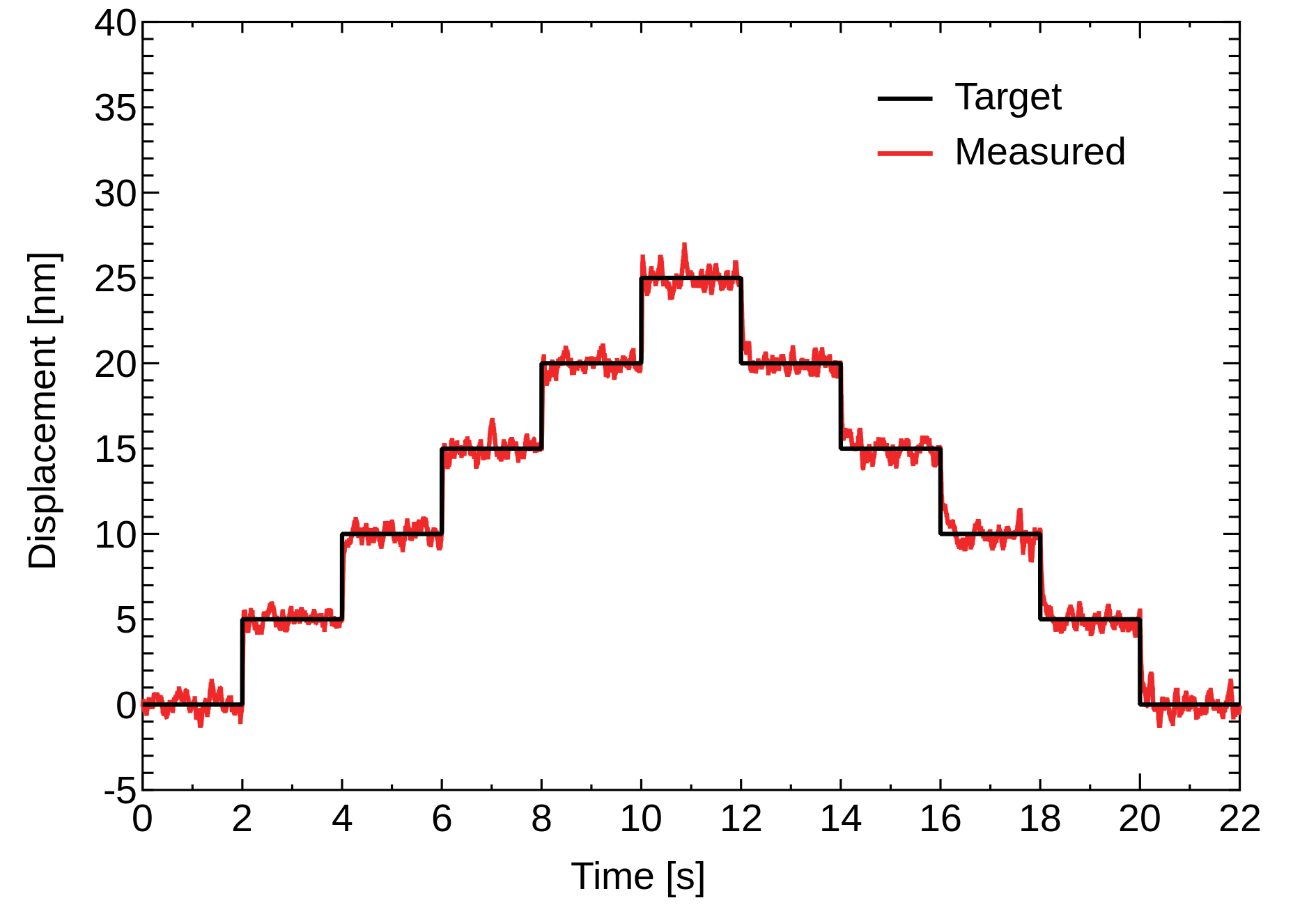
| ● High-precision arbitrary point positioning control remains a bottleneck for precision robotic applications Pneumatic actuators, taking advantage of their high power-to-weight ratio and high-speed operation, are mainly used in production lines in industries such as food processing and automotive manufacturing, serving as control devices for workpiece transfer through end-point positioning. However, due to challenges such as the elasticity of air and the nonlinear friction characteristics during stopping and motion, precise arbitrary-position control is difficult. Consequently, the application of pneumatic actuators to industrial fields requiring high-precision positioning, such as robotics, remains limited (Figure 1). ● Technical Challenge: Proposal of a Novel Positioning Control Technology to Overcome the Elasticity of Air and Nonlinear Friction Characteristics In this study, we propose a high-precision positioning technique based on a control method that focuses, not on the magnitude but on the state of position error. This approach differs from conventional methods, which rely on the time integration of position error. This method suppresses the stick–slip phenomenon, which has been a major obstacle to precision positioning. As a result, nanometer-scale positioning accuracy has been achieved using general-purpose pneumatic actuators: ±5 nanometers for linear motion (Figs. 2 and 3) and less than ±1/10,000 degree for rotational motion. |
|||
| Potential Applications and Commercialization Prospects | |||
|
● Essential Features of Pneumatic Control: Leveraging High Power-to-Weight Ratio and High-Speed Operation for Applications in High-Load and Precision Tasks, Such as Robotics This technology is composed as a compensator, not as a main controller, which allows switching of the compensatory input according to the task. When applied to collaborative robots, for example, the OFF state ensures safety during contact through the elasticity of air in the robot's hand, while the ON state enables high-precision operations via high-gain control. Furthermore, because this technology is not limited to specific physical quantities, it can be applied to velocity or force control, and is compatible with various actuation media, including oil hydraulic and electric actuators.
|
| Patents | ● Patent application pending | ||
Last updated date:October 15, 2026
| Simple Inquiry | Technical consultation | Academic guidance system | Joint research/commissioned research |