│Return to list│Previous page│Next page│
| <E-03>:Civil Engineering, Architecture, Environmental Science |   |
Development of a High-Accuracy, High-Speed Tsunami Simulator (JAGURS)
― For Probabilistic Evaluation of Tsunami Events Toward Optimal Disaster countermeasures ―
| Toshitaka Baba | Professor |
| Disaster Science and Mitigation, Civil and Environmental Engineering, Division of Science and Technology, Graduate School of Technology, Industrial and Social Sciences | |
| Keywords | Probabilistic Tsunami Hazard Assessment, Nankai Trough Earthquake |
| Laboratory URL | https://www.toshitaka-baba.com/ |
| Research Overview | |
| ● Probabilistic evaluation of disaster events is essential for implementing optimal countermeasures Concerns have been raised regarding tsunamis generated by a potential Nankai Trough earthquake, and discussions based on hazard maps are ongoing. However, relying solely on worst-case scenarios, such as a magnitude 9 earthquake, makes it difficult to prioritize disaster mitigation measures. Ideally, risk assessment should consider both the severity of damage and the frequency of occurrence. Achieving this would enable more efficient countermeasures from a cost–benefit perspective and lead to the appropriate setting of earthquake insurance premiums. ● Technical challenge: development of a high-speed tsunami simulator Probabilistic tsunami hazard assessment requires tsunami simulations for an enormous number of scenarios. For example, in the case of a giant Nankai Trough earthquake, depending on the modeling approach, tens of thousands of tsunami simulations may be required at high spatial resolutions on the order of several meters. Therefore, the development of a high-speed tsunami simulator is essential. |
 Fig. 1 Example of probabilistic tsunami inundation assessment (Warm colors indicate higher tsunami risk.) |
| Expected Applications and Product / Commercialization Concept | |
| ● Tsunami Simulator: JAGURS Our laboratory has been continuously developing JAGURS, a high-speed and high-accuracy tsunami simulator. High computational performance is achieved through parallelization using OpenMP and MPI, while high accuracy is pursued through international collaborative development. Institutions involved in the development include Tokushima University, The University of Tokyo, Japan Agency for Marine-Earth Science and Technology (JAMSTEC), National Research Institute for Earth Science and Disaster Resilience (NIED), The Australian National University, Meteorological Research Institute, and Kyoto University. JAGURS is also highly versatile in terms of functionality. In addition to seismic tsunamis, it can simulate tsunamis caused by submarine landslides and meteotsunamis. Support for storm surge simulations induced by typhoons is also expected to be added soon. |
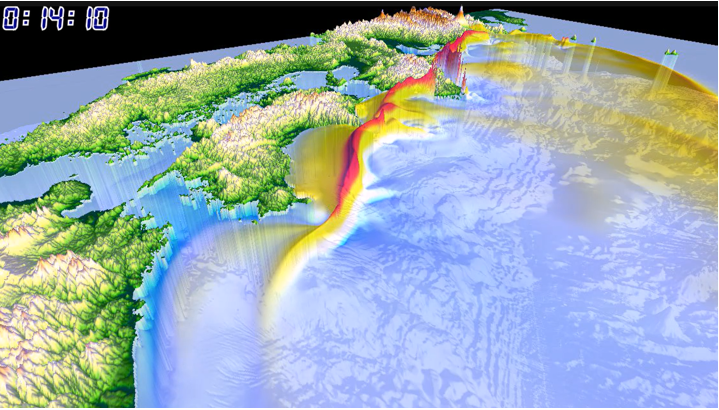 Fig. 2 Tsunami simulation using JAGURS |
| Publications | ● Baba, T., et al. (2022) Probabilistic tsunami hazard assessment based on the Gutenberg–Richter law in eastern Shikoku, Nankai subduction zone, Japan, Earth, Planets and Space, 74, 156. https://doi.org/10.1186/s40623-022-01715-1 ● Baba, T., et al. (2015), Parallel implementation of dispersive tsunami wave modeling with a nesting algorithm for the 2011 Tohoku tsunami, Pure Appl. Geophys., 172, 3455–3472. https://doi.org/10.1007/s00024-015-1049-2 |
Last updated date:October 15, 2026
| Simple Inquiry | Technical consultation | Academic guidance system | Joint research/commissioned research |