│Return to list│Previous page│Next page│
| <E-01>:Mechanical Engineering, Environmental Science, Energy Engineering |    |
Miniaturization and High-Power Output of Small Hydropower Generation Using a Contra-Rotating Rotor
― Effective Utilization of Energy Losses through a Pressure-Reducing Valve Equipped with an Inline Small Hydroturbine ―
| Toru Shigemitsu | Professor |
| Energy System, Mechanical Science, Division of Science and Technology, Graduate School of Technology, Industrial and Social Sciences | |
| Keywords | Turbomachinery, Contra-Rotating Impellers, Computational Fluid Dynamics, Inline Turbine, Miniaturization, High Power Output |
| Laboratory URL | http://pub2.db.tokushima-u.ac.jp/ERD/person/140130/profile-ja.html |
| Research Overview | |||
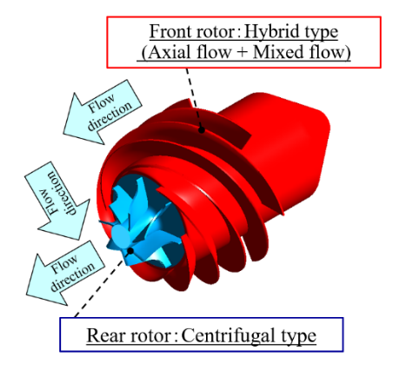
| ● Establishing high-performance design methods for contra-rotating rotors remains a bottleneck Owing to their high-power density and torque cancellation effect, contra-rotating rotors have been commercialized in applications such as electronic device cooling fans and drones, where compactness and lightweight design are required. However, because the two-stage rotors rotate in opposite directions (Fig. 1), the internal flow becomes highly complex. As a result, high-performance design methodologies based on high-accuracy numerical flow analysis capable of quantitatively capturing velocity and pressure distributions have not yet been fully established, preventing the technology from achieving its full potential. ● High-accuracy numerical flow analysis and high-performance design methodology Contra-rotating rotors have been applied to inline small hydroturbines and axial-flow fans, and their internal flow characteristics have been clarified through high-accuracy computational fluid dynamics (CFD) analysis. Based on these findings, a high-performance design methodology for contra-rotating rotors has been established, enabling the development of an inline, high-power, small axial-flow hydroturbine with a turbine diameter of less than 100 mm (Fig. 2). Currently, new contra-rotating rotor configurations combining mixed-flow and axial-flow hybrid rotors with centrifugal rotors (Fig. 3) are being proposed and investigated to achieve higher pressure and efficiency. |
|||
| Expected Applications and Product / Commercialization Concept | |||
|
● Effective utilization of energy losses using a pressure-reducing valve with an inline small hydroturbine The contra-rotating rotor turbine (100 mm diameter) can generate the maximum output of 1 kW under conditions of a pressure of 1 kg/cm² and a flow rate of 5–20 L/s, achieving a power output 2–10 times higher than that of conventional configurations.
|


| Patents | ● Japanese Patent No. 7080470 “Contra-Rotating Rotor and Fluid Machinery” | ||
Last updated date:October 15, 2026
| Simple Inquiry | Technical consultation | Academic guidance system | Joint research/commissioned research |