│Return to list│Previous page│Next page│
| <L-02>:Life Science, Pharmaceutical Sciences |   |
Toward Widespread Clinical and Societal Adoption of Ultra-High-Sensitivity MRI
― Nuclear Spin Polarization Technology via Eutectic and Co-Crystal Methods ―
| Munehiro Inukai | Associate Professor |
| Physical Sciences, Natural Science, Division of Science and Technology, Graduate School of Technology, Industrial and Social Sciences | |
| Keywords | Nuclear spin, polarization, NMR, MRI, NMR-based drug discovery screening, ultra-high-sensitivity MRI |
| Laboratory URL | http://ssip.pm.tokushima-u.ac.jp/~lab/index.html |
| Research Overview | ||
| ● The High Cost of Cryogenic Systems as a Bottleneck to the Widespread Use of Ultra-High-Sensitivity MRI Based on Nuclear Spin Polarization Nuclear magnetic resonance (NMR) enables detailed investigation of the structure and dynamics of compounds by detecting nuclear spins, which behave like tiny magnets. Magnetic resonance imaging (MRI) visualizes the distribution of hydrogen spins in water molecules within the human body. Nuclear spin polarization, which aligns nuclear spin orientations, has attracted attention as a quantum technology capable of dramatically enhancing the sensitivity of NMR and MRI (by factors of 100 to more than 10,000). There is strong demand for its development in the fields of materials science, drug discovery, and medical fields. For example, pyruvate is well known as an MRI molecular probe for tumor detection, and polarization of pyruvate is one of the key research topics enabling ultra-high-sensitivity MRI for cancer imaging. ● Technical Challenge: Proposal of a Cryogen-Free Ultra-High-Sensitivity NMR/MRI Method Using Eutectic and Co-Crystal Systems In this research, we focus on crystals composed of two or more organic molecules, such as eutectic and co-crystal systems, and develop nuclear spin polarization technologies for MRI molecular probes and pharmaceuticals. Conventional approaches rely on cryogenic cooling to achieve nuclear spin polarization; in contrast, our method uses light instead of ultra-low temperatures to polarize nuclear spins. This approach enables nuclear spin polarization at room temperature and eliminates the need for any cryogenic agents, offering significant practical advantages. |
||
| Potential Applications and Commercialization Prospects | ||
| ● Dissemination of Ultra-High-Sensitivity Clinical MRI and Applications to NMR-Based Drug Discovery Screening This technology is expected to enable ultra-high-sensitivity NMR and MRI measurements by exploiting the long polarization (relaxation) times inherent to eutectic and co-crystal systems. In addition, nuclear spin polarization can be achieved using compact and low-cost equipment that does not require cryogenic agents. By installing a polarization unit adjacent to existing NMR or MRI systems, their measurement sensitivity can be significantly enhanced. In the future, this technology will be applicable to a wide range of MRI-equipped medical institutions, including regional and community hospitals. |
||
 Figure 1. External View of the MRI System and Nuclear Spin Polarization |
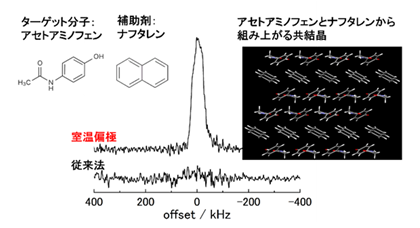 Figure 2. Example of Nuclear Spin Polarization in a Cocrystal Polarization enhances the ^1H NMR signal by more than 100-fold. |
|
| ● Diagram explanation Conventional NMR/MRI Upward and downward nuclear spins cancel each other’s signals, leaving only a very small fraction of nuclear spins available for detection. This Study: NMR/MRI with Room-Temperature Nuclear Spin Polarization By aligning the orientations of nuclear spins, the signal intensity is dramatically amplified (by more than 10,000-fold), enabling ultra-high-sensitivity NMR and MRI at room temperature. |
・ターゲット分子:アセトアミノフェン Target Molecule: Acetaminophen ・補助剤:ナフタレン Additive: Naphthalene ・アセトアミノフェンとナフタレンから組み上がる共結晶 Co-crystal Formed from Acetaminophen and Naphthalene ・室温偏極 Room-Temperature Polarization ・従来法 Conventional Method |
|
| Patents | ● Japanese Patent Publication No. 2025-086942 “HIGHLY POLARIZED OBJECT, METHOD FOR PRODUCING SAME, HIGH POLARIZATION METHOD, AND HIGH POLARIZATION DEVICE” |
|
Last updated date:October 15, 2026
| Simple Inquiry | Technical consultation | Academic guidance system | Joint research/commissioned research |