│Return to list│Previous page│Next page│
| <L-15>:Life Science, Pharmaceutical Sciences |  |
Regulation of Fibrocytes by Clock Gene Inhibitors and Their Application to Cancer Therapy
― Toward the Development of Novel Treatments to Overcome Resistance to Immunotherapy ―
| Atsushi Mitsuhashi | Designated Associate Professor |
| Department of Respiratory Medicine and Rheumatology, Graduate School of Biomedical Sciences | |
| Yasuhiko Nishioka | Professor |
| Department of Respiratory Medicine and Rheumatology, Graduate School of Biomedical Sciences | |
| Keywords | Clock genes, fibrocytes, cancer immunotherapy, biomarkers |
| Laboratory URL | http://www.sannai.umin.jp/ |
| Research Overview | ||||
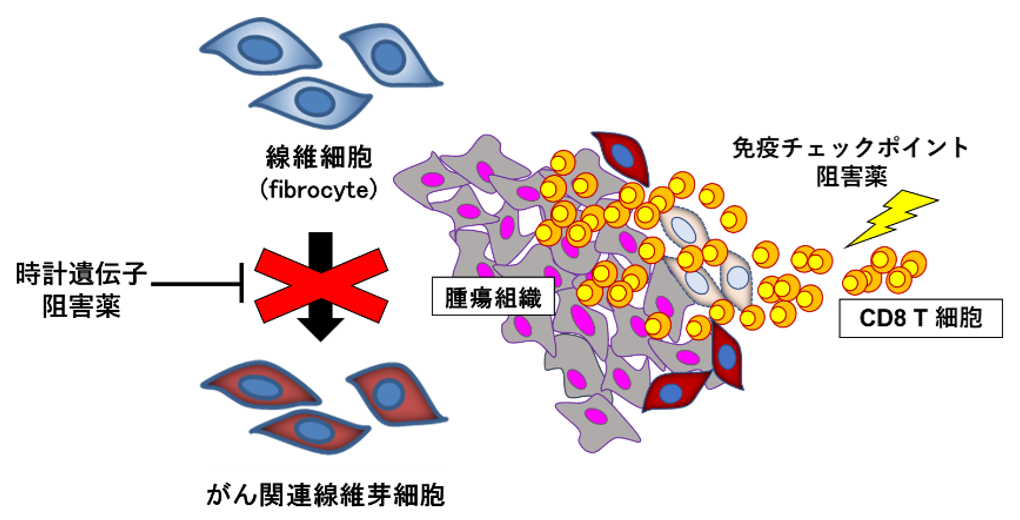
| ● Tumor Stroma Contributes to the Efficacy of Immunotherapy Fibrocytes are hematopoietic-derived cells capable of producing collagen and are known to play important roles in organ fibrosis; however, their functions in cancer remain largely unclear. Immune-based therapies, such as immune checkpoint inhibitors, currently represent a central strategy in cancer treatment. Nevertheless, tumor stroma—particularly cancer-associated fibroblasts—can inhibit immune cell infiltration, leading to immune exclusion and therapeutic resistance. In this study, we focused on the role of fibrocytes in regulating the tumor stroma and their contribution to immune exclusion. ● Technical Challenge:Elucidation of the Mechanisms Regulating Fibrocyte Differentiation Fibrocytes have long been considered difficult to isolate from tissues; however, by identifying specific surface markers, we independently established a method to isolate fibrocytes from tumors and demonstrated their differentiation into fibroblasts. Furthermore, we identified clock gene pathways—known regulators of circadian rhythms—as key mechanisms for controlling fibrocyte differentiation. Although pharmacological inhibitors targeting clock gene function have already been developed, their application in cancer immunotherapy has not been explored. This study aims to leverage clock gene inhibition as a novel strategy to overcome immune exclusion. |
||||
| Potential Applications and Commercialization Prospects | ||||
| ● Inhibition of Fibrocyte Differentiation by Circadian Rhythm–Extending Agents to Overcome Immunotherapy Resistance The technique for isolating fibrocytes from tumors enables the investigation of mechanisms regulating their differentiation into fibroblasts, as well as the screening of compounds that affect this process. As a representative example, we confirmed that the existing clock gene inhibitor KL001 suppresses fibrocyte differentiation and exerts antitumor effects while overcoming immune exclusion in mouse models. By combining agents that suppress fibrocyte differentiation—particularly clock gene inhibitors—with immunotherapy, this approach offers a strategy for developing novel cancer treatments capable of overcoming therapeutic resistance.
|

| Patents | ● Japanese Patent Publication No. 2025-158434 "Composition Containing a Circadian Rhythm–Extending Agent and Its Use" |
| Publications | ● Mitsuhashi A, Koyama K, Ogino H, Afroj T, Nguyen NT, Yoneda H, Otsuka K, Sugimoto M, Kondoh O, Nokihara H, Hanibuchi M, Takizawa H, Shinohara T, Nishioka Y. Identification of fibrocyte cluster in tumors reveals the role in antitumor immunity by PD-L1 blockade. Cell Rep 42(3):112162, 2023. doi: 10.1016/j.celrep.2023.112162. ● Mitsuhashi A, Koyama K, Ogino H, Matsuo R, Nguyen NT, Yabuki Y, Ozaki R, Tsukazaki Y, Morita Y, Yoshida A, Murakami K, Sato S, Kawano H, Nokihara H, Inagaki Y, Shinohara T, Hanibuchi M, Takizawa H, Nishioka Y. Clock pathway inhibitor overcomes tumor immune-exclusion via regulation of fibrocyte differentiation. NPJ Precis Oncol 9(1):274, 2025. |
Last updated date:October 15, 2026
| Simple Inquiry | Technical consultation | Academic guidance system | Joint research/commissioned research |